Supermarine Spitfire
Historic type, drawn for the library · Military
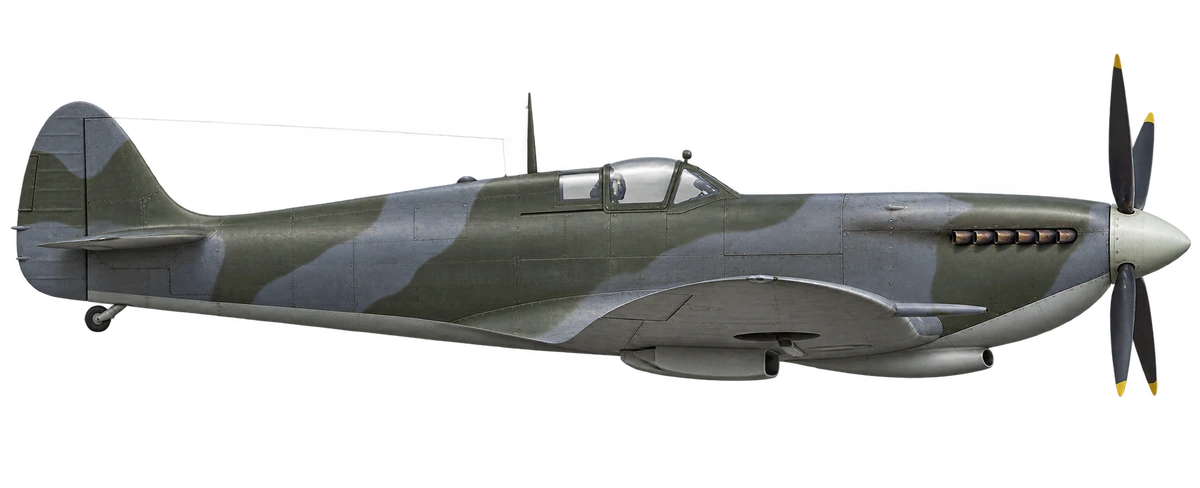
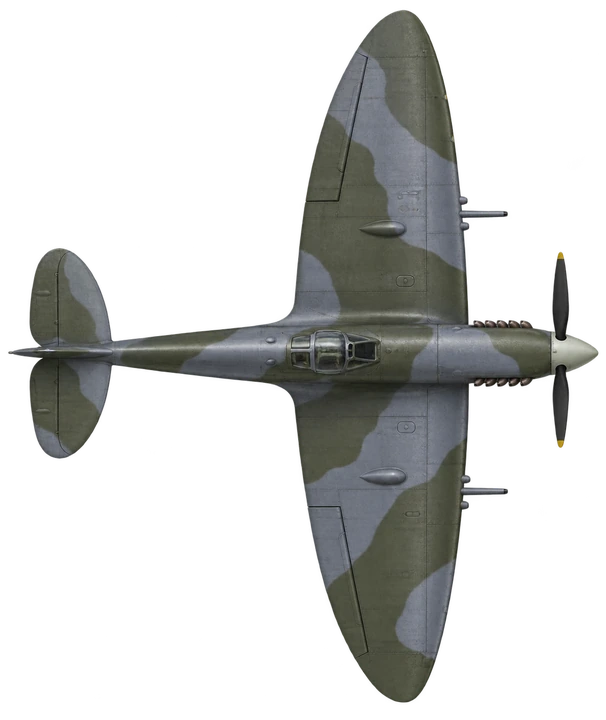
Explore the Supermarine Spitfire in side view and top view to compare its silhouette and proportions.
From Wikipedia
The Supermarine Spitfire is a British single-seat fighter aircraft that was used by the Royal Air Force and other Allied countries before, during, and after World War II. It was the only British fighter produced continuously throughout the war. The Spitfire was a short-range, high-performance interceptor aircraft designed by R. J. Mitchell, chief designer at Supermarine Aviation Works, which operated as a subsidiary of Vickers-Armstrong from 1928. Mitchell modified the Spitfire's distinctive elliptical wing with innovative sunken rivets to have the thinnest possible cross-section, achieving a potential top speed greater than that of several contemporary fighter aircraft, including the Hawker Hurricane. Mitchell continued to refine the design until his death from cancer in 1937, whereupon his colleague Joseph Smith took over as chief designer.
Summary of “Supermarine Spitfire” from Wikipedia, the free encyclopedia, used under CC BY-SA 4.0. Retrieved 2026-10-11.
Download


Free to use, with credit
Use these drawings for anything, commercial too, under Creative Commons Attribution 4.0 International. Credit us like this:
Drawing of the Supermarine Spitfire by AirwayControl Aircraft Library (https://aircraft.intelsystems.ai/aircraft/SPIT/), CC BY 4.0Specifications
- Length
- 9.47 m31.1 ft
- Wingspan
- 11.23 m36.8 ft
- Max take-off weight
- 3.4 t7,500 lb
- Max speed
- 657 km/h408 mph
- Range
- 700 km435 mi
- Ceiling
- 13,100 m43,000 ft
- Engines
- 1× Rolls-Royce Merlin 61
- Power
- 1,565 hp
- First flight
- 1936
- In service
- 1938
From the AirwayControl spec register, curated from Wikipedia and manufacturer pages. Figures vary by variant.